October 13, 2026
Best Vegetable Chopper for Meal Prep: Built for Sundays
This post contains affiliate links. As an Amazon Associate, I earn from qualifying purchases, at no extra cost to you.
The short version
You spend Sunday dicing a week's worth of lunches, eyes watering, knife hand cramping. A press chopper can take that session from miserable to mechanical — but only if it survives the whole batch, not just one onion. For onion-and-pepper-heavy Sunday prep, the evidence points to the Fullstar 4-in-1: fastest in the timed tests reviewers ran, the easiest to clean, and the only one with replacement parts for when the hinge wears out. Your gain: the batch gets done before the tears start, and the thing doesn't become drawer clutter by spring.
Caption: The batch claim, stated plainly — ten onions, two minutes, zero tears, per reviewer reports.
Check these 3 things first
Before any product name matters, check your own routine. A chopper only pays off if all three pass.
| # | Check | Pass rule |
|---|---|---|
| 1 | Batch fit | Your Sunday quantity fits without constant emptying. The tray holds about 5 cups — a 10-onion batch means mid-batch empties. Know your number before you buy. |
| 2 | Rinse discipline | You'll rinse the blade grid right after use. If it'll sit in the sink, dried food turns a 1-minute rinse into a 5–10 minute scrub — and the time savings evaporate. |
| 3 | Press effort | You can press firmly and repeatedly, or you stick to softer veg. Hard roots like carrots and sweet potatoes need pre-cutting or real force. |
The problem it solves
Sunday, 4pm. You've got five days of lunches to build and a pile of onions that will make you cry before you're halfway done. Knife work isn't just slow — it's the tears slowing you down, the cutting board swimming in juice, the counter covered in little onion skins. What disappears with the right chopper isn't just minutes. It's the dread. The enclosed container catches everything, the tears never start, and the uniform dice means your sheet-pan veggies actually finish at the same time instead of half-burnt, half-raw.
Candidates through your criteria
| Candidate | Batch fit | Rinse discipline | Press effort | One-line reason |
|---|---|---|---|---|
| Fullstar 4-in-1 | ✅ Pass | ✅ Pass (comb included) | ✅ Pass | Fastest in timed tests; cleaning comb ships in the box |
| Mueller 4-blade | ✅ Pass | ⚠️ Pass with care | ✅ Pass | Same press-chopper idea; thinner grid traps more food, so rinsing matters more |
Specs that matter
| Spec | Fullstar 4-in-1 | Mueller 4-blade | What this means in practice |
|---|---|---|---|
| Blades | 420 stainless steel, rust-resistant (VERIFIED — manufacturer) | Stainless steel press blades (attributed) | Both stay sharp through weekly use; one ~2-year user reports blades still sharp |
| Tray capacity | 1.2L, about 5 cups (VERIFIED — manufacturer) | About 3 cups ([UNVERIFIED] — one review) | You'll empty the Mueller mid-batch on a big Sunday; the Fullstar goes longer |
| Dishwasher safe | Top rack (VERIFIED — manufacturer) | Yes (attributed) | Either way, rinse first — the dishwasher can't dissolve dried-on onion |
| Handle/base | Soft-grip TPU handle, non-skid base (VERIFIED — manufacturer) | Standard press top (attributed) | The Fullstar's grip matters if your hands tire easily |
| In the box | Cleaning comb included (attributed) | Cleaning brush included (attributed) | The comb only helps if you rinse before food dries |
How it performs
Will it actually save me time on a full Sunday batch — not just one onion?
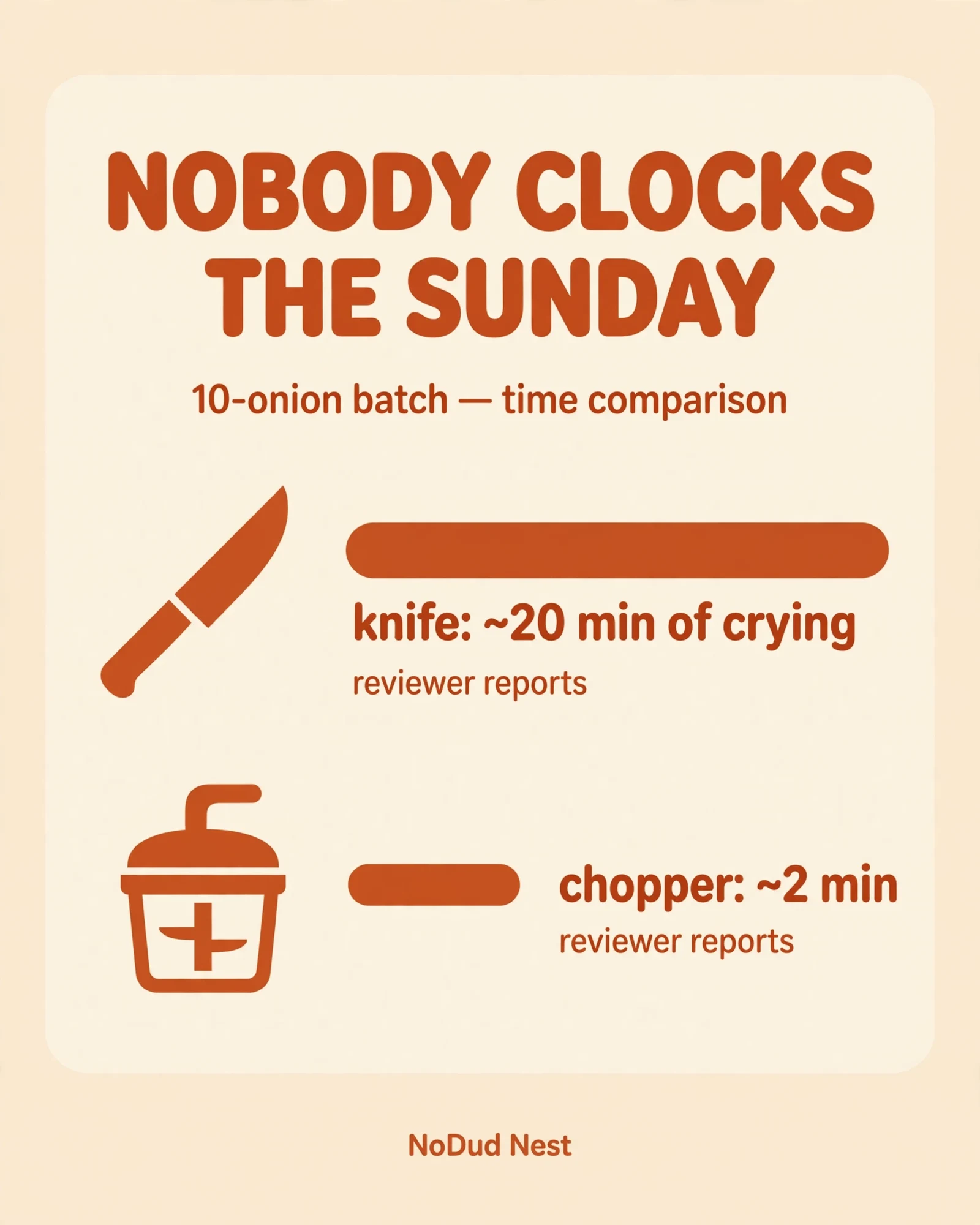
Here's what reviews get wrong: they clock a single onion. Eight seconds for the Fullstar, ten for the Mueller, per one timed test. Cute. Nobody clocks the Sunday.
The math that matters is the batch. One verified buyer dices 10 onions every Sunday: about 20 minutes of crying with a knife, about 2 minutes with the chopper. A week-long hands-on test found at least thirty minutes saved per week. Why does it compound? The enclosed container kills the two things that make knife batching miserable — the tear slowdowns and the counter mess. Speed per onion is a party trick; speed per batch is the purchase.
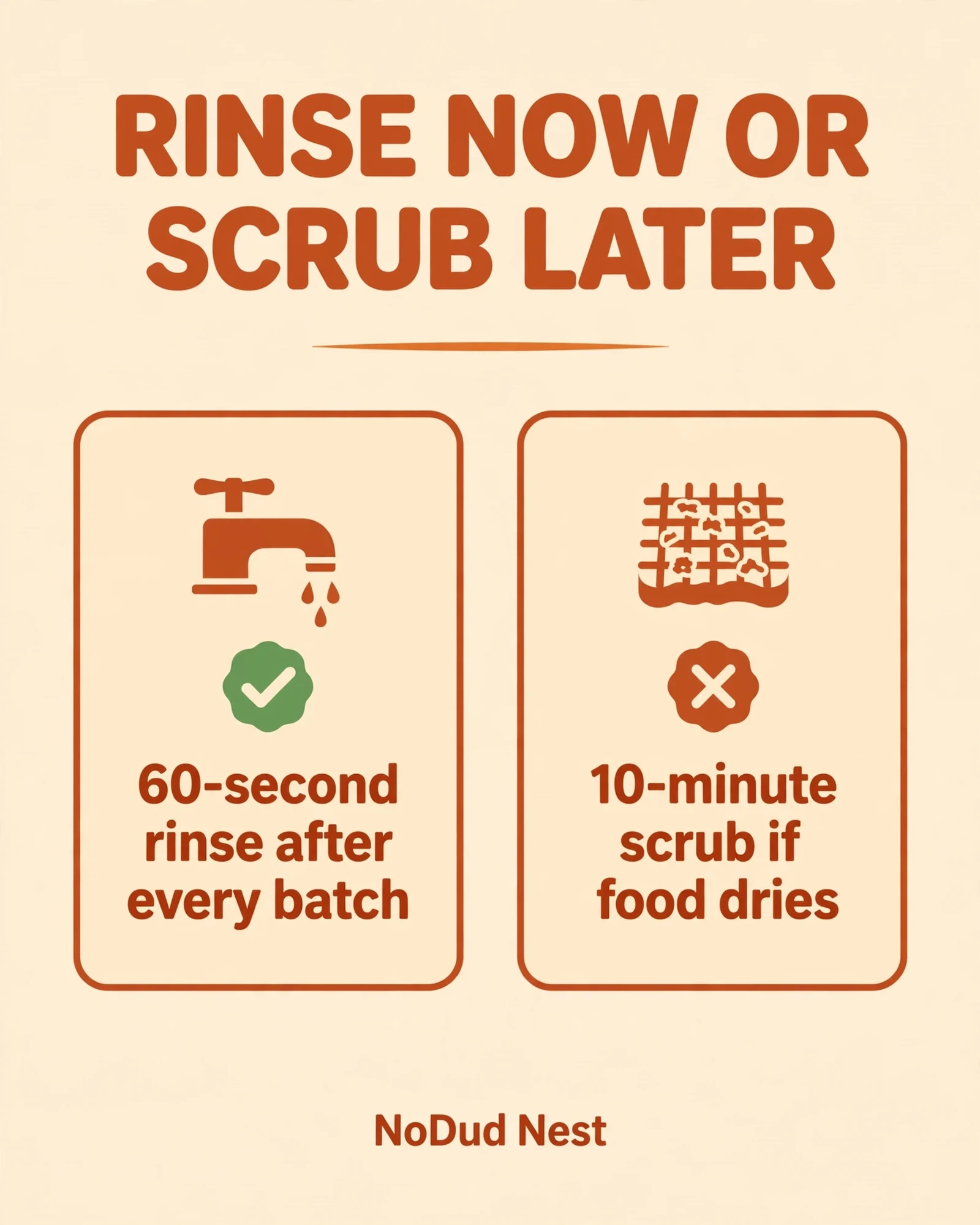
The catch is cleanup, and it's the whole game. Rinse the blade grid right after use and it's a minute. Let food dry on and reviewers report 5–10 minutes of scrubbing — at which point you've given back everything you saved. This is a rinse-immediately tool. If that's not you, the knife wins.
Will it survive months of weekly batch sessions, or crack by spring?
The hinge. That's the answer, and it's the thing one-week reviews can't catch.
User reports across brands describe plastic hinge mechanisms breaking after roughly 3–4 months of regular use — the most consistent structural complaint in the evidence. One Brieftons user went through two units. A ~2-year Fullstar user reports the blades stayed sharp while the catch tray eventually fatigued from dishwasher cycles, which is normal plastic aging.
Here's the honest framing: no source ran a controlled long-term hinge test, so treat the 3–4 month figure as a check-before-you-buy, not a fact. What you can do: buy from a reputable seller (knock-offs are reported), don't force hard veg through it, and know that Fullstar sells replacement blades and parts — the unit is repairable, not disposable. We found no replacement-parts program for Mueller.
Can I press it without wrecking my hands?
Reviewers sometimes list "requires pressing force" as a mild con — but they're comparing it to electric choppers. Name the right alternative and the con flips: compared to a knife, one downward press beats dozens of strokes. An arthritis sufferer's verified-buyer report: she pushes down with one hand and gets even dice every time.
The Fullstar's soft-grip TPU handle and non-skid base are manufacturer-verified, and they matter here — the base keeps the unit planted so your effort goes into the press, not into chasing it across the counter. For hard roots, pre-cut into chunks first; no press chopper likes a whole sweet potato.
What will annoy me that reviews don't mention?
Three things. First, the blades are genuinely razor sharp — one user nicked a thumb on day two. Handle by the housing, use the guard, keep it away from kids. Second, one blade makes one dice size. Reviewers call that a limitation; your sheet pan calls it even roasting — identical cuts finish at the same time. Third, counterfeits exist. If the listing looks off, buy from a reputable seller.
What it's bad at
- The hinge is the weak point. Plastic hinge mechanisms are the #1 structural complaint under repeated use. It's repairable (Fullstar sells parts), not indestructible.
- Hard vegetables need prep. Whole carrots and sweet potatoes need chunking first, or you'll be forcing it — and forcing it is how hinges die young.
- Small batches only. It's a Sunday-prep tool, not a party tool. Cooking for a crowd? A food processor wins.
- One dice size per blade. Fine for batch cooking (even cooking), limiting if you want variety without swapping blades.
- It demands rinsing. Leave it dirty and cleanup becomes the chore you bought it to escape.
When NOT to buy this
- You cook once a week or less. One reviewer put it well: if you live on takeout, this is drawer clutter. It earns its slot through repetition.
- You regularly cook for large gatherings. The 5-cup tray isn't built for party-scale prep.
- You won't rinse right after use. Dried-on food turns the one-minute rinse into a scrub session. Be honest with yourself here.
- Your prep is mostly big hard roots and you won't pre-cut. You'll fight the tool every Sunday.
- Young kids would use it unsupervised. The blades are razor sharp. Non-negotiable.
Who should buy — persona picks
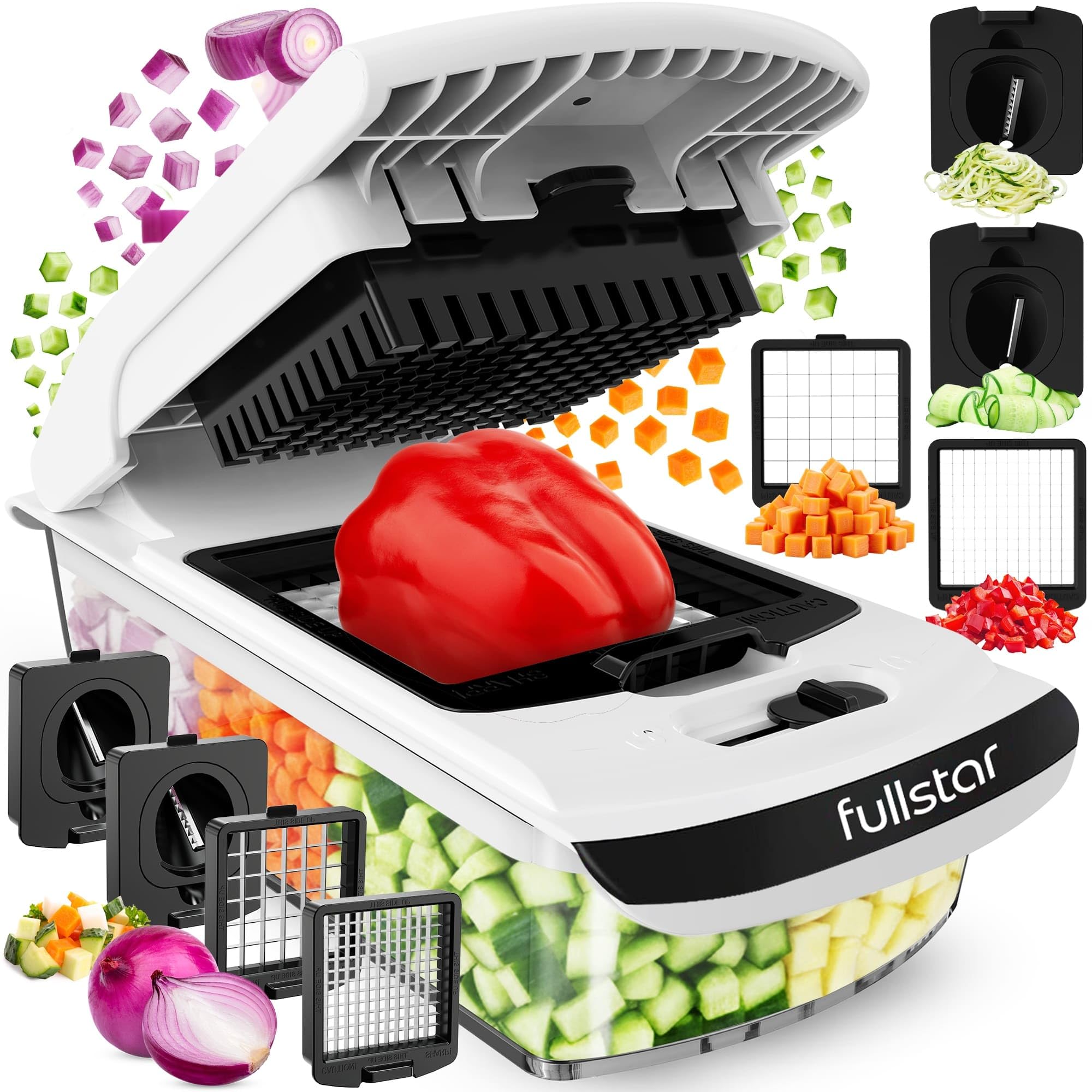
The Sunday batch prepper: Fullstar 4-in-1. This is the hero case — five days of lunches, onions and peppers by the pile. The Fullstar was built for exactly this routine: fastest in the timed tests reviewers ran, the cleaning comb in the box, the enclosed container that ends the tear problem, and uniform dice so the roast comes out even. When the hinge eventually wears, replacement parts exist. Niche intent: speed on soft veg plus fast cleanup, for the person who does this every single week.
The weak-hands cook: Fullstar 4-in-1. If knife work hurts, the deciding factor isn't speed — it's the press. One downward motion replaces dozens of strokes, and a verified buyer with arthritis does it one-handed. The soft-grip handle and non-skid base aren't marketing here; they're the difference between cooking and not cooking.
The dense-veg prepper: Mueller 4-blade. If your Sundays are mostly carrots, sweet potatoes, and hard roots, the calculus shifts — reviewers note the Mueller's grid holds up slightly better on dense vegetables. Same press-chopper simplicity, matched to the harder workload. Note: match the 4-blade press-chopper variant before you buy — Mueller sells several lookalikes (including a "Pro Series" that isn't the tested unit).
Who should skip: the once-a-week cook, the party-scale prepper, anyone who won't rinse. The tool is honest about what it needs from you.
Comparison
| Fullstar 4-in-1 | Mueller 4-blade | |
|---|---|---|
| Built for | Onion/pepper-heavy weekly batches | Dense-root-heavy prep |
| Timed speed | Faster per test (8s vs 10s per onion, attributed) | Slightly slower per test |
| Cleanup | Comb included; wider grid rinses easier | Brush included; thinner grid traps more food |
| Tray | ~5 cups (VERIFIED) | ~3 cups ([UNVERIFIED]) |
| Weak spot | Hinge fatigue (parts replaceable) | Hinge fatigue (no parts program found) |
| Match | Sunday batch prepper, weak-hands cook | Dense-veg prepper |
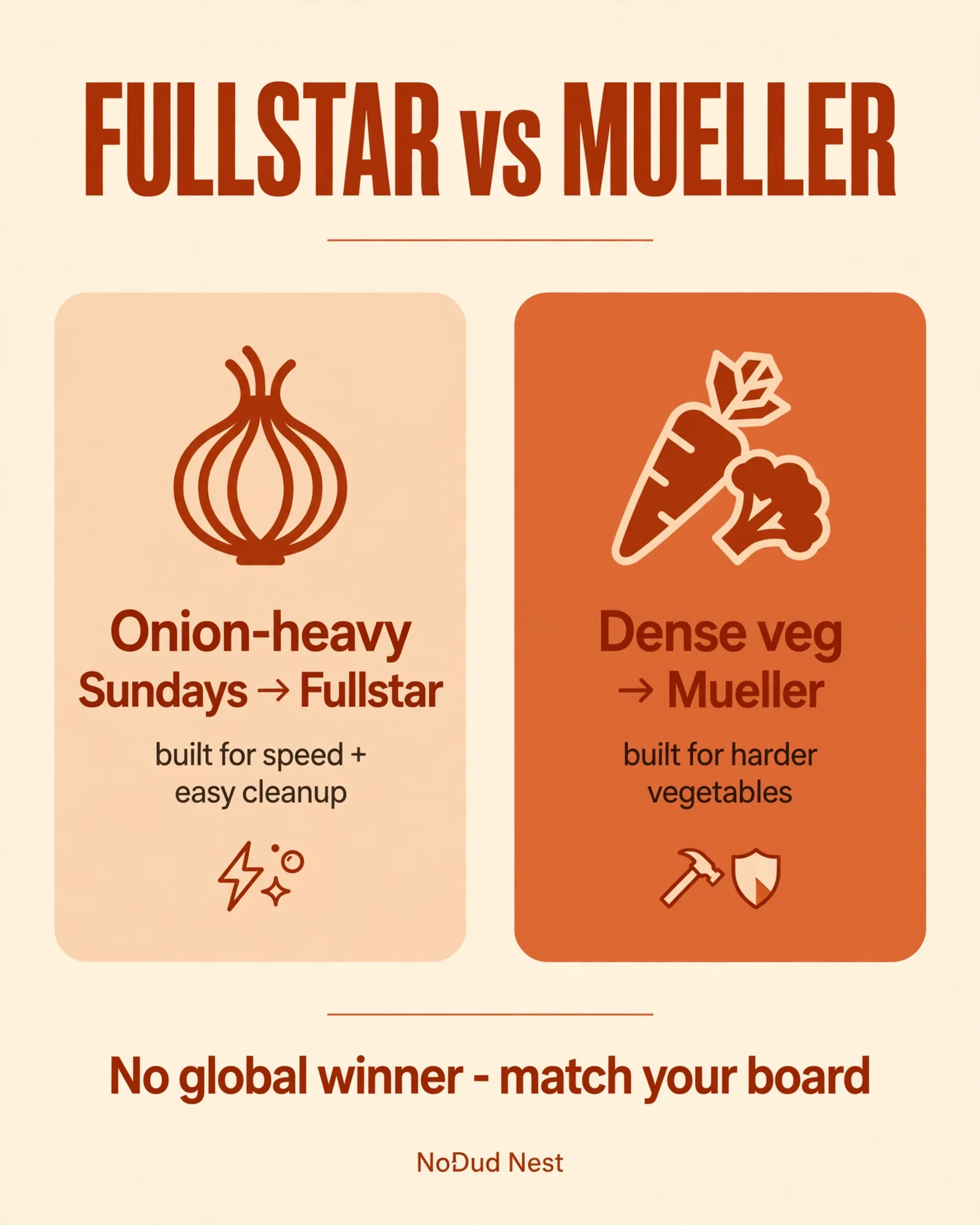
One line per persona: batch prepper → Fullstar. Weak hands → Fullstar. Dense roots → Mueller. Nobody gets crowned — each one was built for its lane.
Before you buy checklist
- Match the variant. 4-blade vs 6-in-1 vs 9/10-in-1 are different products. Confirm the listing shows the 4-blade press chopper before buying.
- Buy from a reputable seller. Counterfeits are reported — a suspicious listing isn't worth the gamble.
- Measure your batch. If you regularly exceed ~5 cups per session, plan on mid-batch empties or size up your strategy.
- Get a cut glove. The blades are razor sharp; a cheap cut-resistant glove is the smartest accessory here.
- Commit to the rinse. The whole value proposition depends on rinsing the grid right after use.
FAQ
Are vegetable choppers actually worth it?
Only if you prep regularly. For a weekly batch cook, reviewers report thirty-plus minutes saved per week. For occasional cooking, it's drawer clutter — one reviewer said exactly that.
Do they really stop onion tears?
Yes — and it's the most corroborated claim in the evidence. The enclosed container traps the irritants before they reach your eyes. "Zero tears" shows up across independent sources.
Can it handle carrots and sweet potatoes?
With pre-cutting, yes. Whole hard roots need chunking first — forcing them through is what kills hinges. If dense veg dominates your prep, the Mueller's grid gets the nod from reviewers.
How do you clean it without hating your life?
Rinse the blade grid immediately after use — one minute. Let food dry and it becomes a 5–10 minute scrub. The included comb or brush only helps on wet residue.
Fullstar vs Mueller — just tell me which one.
It depends on your veg list, not on a ranking. Onion-and-pepper-heavy Sundays → Fullstar (faster, easier cleanup, replaceable parts). Dense-root-heavy prep → Mueller (better hard-veg handling per reviewers). That's the whole decision.
Keep reading
- How we pick products — our method, in plain language
- Why we aggregate reviewer tests instead of claiming our own — what NoDud Nest is and isn't
Final verdict + CTA
No single winner here — just matches. Your Sundays are onions, peppers, and a two-hour batch window: the Fullstar 4-in-1 was built for that routine, and the reviewer evidence backs it — fastest in timed tests, easiest cleanup, parts when the hinge wears. Your prep is mostly hard roots: the Mueller 4-blade's grid is the one reviewers point to. Either way, rinse it right after use — that's the real product manual.
Evidence & method
We reviewed 14 sources: video reviews (transcripts), independent review sites, community threads, and retailer Q&A. Sources were graded A/B/C on measured values, long-term use, specific downsides, and sponsorship — grades adjust confidence, they don't exclude. Specs are labeled VERIFIED only when they come from the manufacturer listing; timed-test numbers are attributed, not verified. No source computed full-batch net time — that's the gap this post is built on. We never claim hands-on testing; every claim traces to a source in the Evidence Pack. Key sources: the Fullstar vs Mueller timed comparison, BuzzFeed's week-long hands-on test, Tom's Guide editorial test, ViralFresh's user-report aggregation, and MyKitchenReview's detailed review.